the passing night train
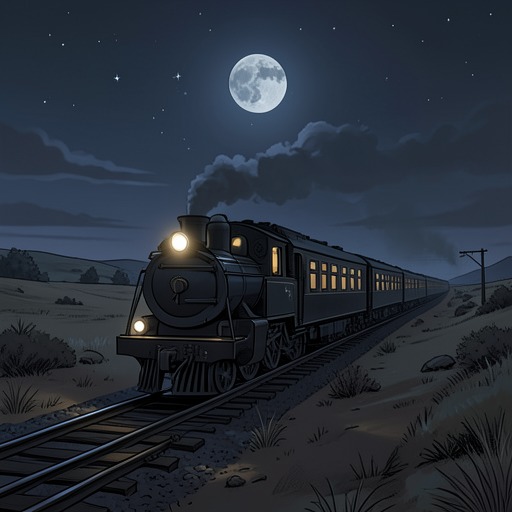
Night TrainThe passing night train recurs as a physical presence in Mike Hoolihan’s life and as an image that gathers meanings the narrative cannot settle into a single explanation. It marks ordinary hours, unsettles the boundaries between sound and expectation, and becomes a metaphor for suicide and the unknowable distance between bodily life and mental suffering. Its significance lies in this double role: the train can be waited for, heard, and timed, while the darkness it comes to represent remains beyond clear understanding.
An Ordinary Presence
The narrative first anchors the passing night train in a specific evening. On March 4, at 20:15, Mike is alone in her apartment, with a biography open beside her on the couch and dinner not yet begun. Tobe is out of town at a computer convention. Mike has just been startled from a doze by the train, which passes early on Sundays. The detail is part of the room’s ordinary arrangement: the train shakes the floor beneath her, but its presence also keeps her rent low. It is at once a disturbance and a practical condition of her housing.
The train’s passage helps establish how Mike registers time. She remembers the hour because its sound has interrupted her sleep, not because she is following a clock or preparing for an event. The narrative’s account of her evening thus makes the train a measure of lived time: a recurring noise that breaks into a private routine and leaves a physical trace in the apartment. On the same night, a call from John Macatitch brings work into that solitude, but the train has already supplied the scene’s first interruption.
Sound, Uncertainty, and Recurrence
A later passage makes the sound harder to identify. Mike wonders whether she hears Tobe starting up the stairs or only the first suggestion of the passing night train. The building seems to anticipate its arrival, as if it braces when the sound approaches. Around this uncertainty, Mike’s account shifts between saying she lives alone and insisting that she lives with Tobe. Deniss, meanwhile, is driving away with his belongings in a U-Haul. The train does not explain these changes in her account, but its uncertain approach shares the passage with them: a familiar sound becomes difficult to separate from the question of who is present.
The train also returns through a distinct auditory image. Before its arrival, Mike describes a sound that seems to her like knives being sharpened, followed by a harsh, layered noise compared to car horns. This is not merely a report of a scheduled passage. The description breaks the sound into a sequence, making anticipation part of the experience: the train is known by signs that precede it as well as by its arrival. The image appears close to a discussion of the gaps in what can be known, so its recurrence carries both a concrete acoustic reference and the strain of trying to make sense of incomplete evidence.
A Metaphor for Suicide
In the passage titled “The Psychological Autopsy,” the passing night train becomes an explicit metaphor for suicide. Mike figures it as a journey toward darkness, chosen through a one-way ticket that costs everything. This image gives the act a direction and a terrible finality, but it does not supply the motive that would make a particular death fully comprehensible. The train provides a way to speak about movement toward an end; it does not reveal why someone boards.
The metaphor is also bound to Mike’s response to Jennifer Rockwell’s death. Mike feels Jennifer’s presence within her as an intruder carrying a flashlight, trying to disclose what Mike does not want to see. In the same reflection, suicide is described as a mind-and-body problem that ends violently without a winner. The train therefore connects the outward fact of a journey with a conflict that cannot be reduced to the visible body alone. Its image gives Mike language for the finality of death while preserving the uncertainty that remains after the death has been examined and discussed.
Habit, Clock Time, and the Limits of Seeing
The train has an earlier place in Mike’s routine as well. After she stops working murder cases, she stays awake until it passes, whenever that may be, and then sleeps for a long stretch. The pattern turns the train into a boundary between wakefulness and rest. Its passage is not fixed to a precise hour in this account; Mike waits for it, and the waiting itself organizes the night. Even at home, it can shake the ground and disturb the crockery, carrying its effects from sound into the objects around her.
That habit gives particular force to a later moment of recognition. At 3:25, Mike realizes that the previous day was Sunday and that the train must have passed hours earlier. The realization arrives late: the event has already occurred, and she has only now placed it in time. The passage then sets the clear sky and excellent visibility on the evening Jennifer died against Mike’s judgment that the seeing was poor. The contrast is not that the train caused a failure of perception, but that a timetable can be reconstructed even when understanding cannot. As a recurring object, the passing night train offers a pattern of arrival and departure; its departures sharpen rather than resolve the narrative’s central uncertainty about what can be known of suicide.